
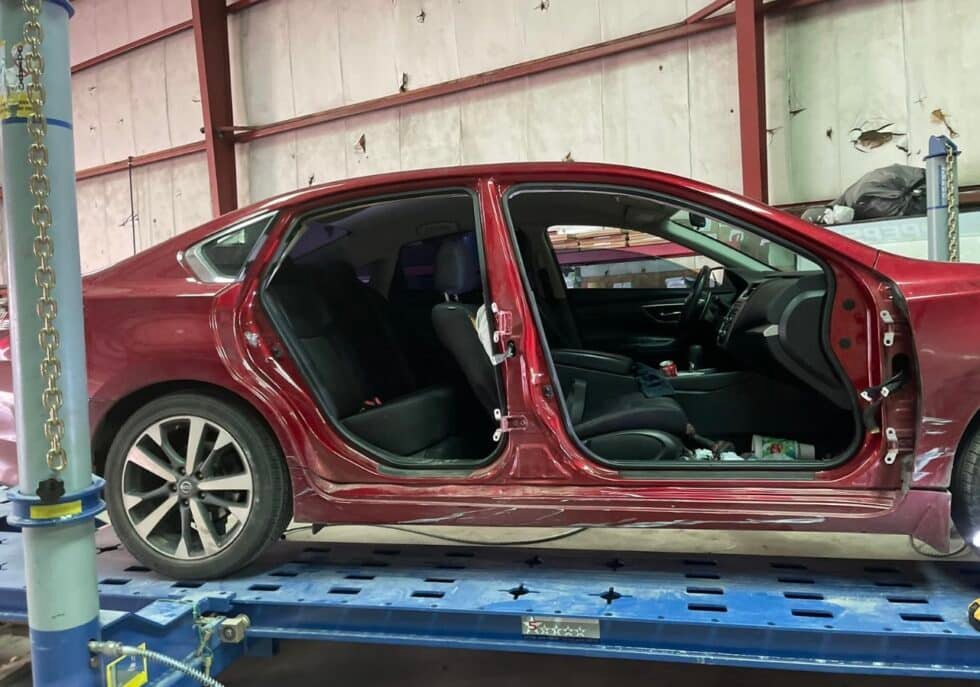
Your car remembers the impact long after the glass is swept away. While a fresh coat of paint might hide the bruises, the vehicle’s skeleton often holds onto the trauma. A chassis misalignment of just three millimeters, roughly the thickness of two pennies, can render automatic braking systems blind and turn engineered crumple zones into rigid traps.
Modern repair isn’t about pulling metal until it “looks straight.” It is a discipline of heavy industrial hydraulics fused with laser-measured geometry, returning your vehicle to the exact blueprint stamped by the factory.
Essential Lessons
- Frame straightening restores the vehicle’s capacity to absorb kinetic energy, protecting you during future accidents.
- A structural shift of less than one millimeter can blind radar and camera sensors, disabling critical safety features.
- Shops utilize drive-on racks for speed and versatile pulling, while dedicated benches offer factory-level precision for heavy hits.
- Lasers and electronic probes verify alignment to the millimeter, far outperforming old-school tape measures.
- Professional frame equipment costs between $40,000 and $200,000, a mandatory expense for shops meeting insurance and OEM safety standards.
The Critical Role of Structural Integrity in Modern Vehicle Safety Systems
Structural repair is the non-negotiable bedrock of passenger safety. Before a technician sprays a drop of primer, the vehicle’s skeleton must match its original architectural design. Frame straightening applies calculated hydraulic pressure to pull the chassis or unibody back to factory specifications. This is not cosmetic work, it is life-saving engineering.
Roughly 75 percent of passenger vehicles on the road today use unibody construction. In this setup, the frame and the body shell are a single, fused unit. Unlike an old pickup truck, where the body sits on top of steel rails, a unibody car is a tensioned cage. A hit to the rear bumper transfers energy through the roof, pillars, and floor pan. This means damage is rarely isolated to the point of impact.
This “skeleton” manages energy during a crash. Engineers design crumple zones to fold like an accordion, absorbing violence so your body doesn’t have to. If a frame remains bent or is cold-worked improperly, those crumple zones fail. The metal might fold too fast or stay rigid, transferring fatal G-forces directly to the driver. Correcting this geometry is the only way to reset the car’s safety rating.
Impact on Advanced Driver Assistance Systems and Sensor Calibration
Physical steel dictates digital behavior. Modern cars rely on Advanced Driver Assistance Systems (ADAS) like automatic emergency braking, lane centering, and blind-spot monitoring. These systems use sensors, cameras, and radars bolted directly to the vehicle’s structure or behind body panels.
If the underlying frame is skewed by a few millimeters, the sensor reads the world incorrectly. A radar sensor shifted by a fraction of an inch at the mounting point can be off by several feet at 100 yards down the road. The computer might miss a stopped car or slam on the brakes for a phantom obstacle in the next lane.
Syed Brothers Auto Body Shop OKC treats structural alignment as the prerequisite for software calibration. We verify that the physical mounting points sit exactly where the blueprints say they should. Without this mechanical accuracy, calibration fails, and safety systems will not meet National Highway Traffic Safety Administration (NHTSA) standards.
Selecting the Right Anchoring System
The collision repair equipment market hovers around 190 billion dollars globally, driven by the need to fix complex aluminum and high-strength steel. In Oklahoma City, professional shops generally deploy two types of straightening systems: drive-on racks and dedicated benches.
Drive-On Racks
Drive-on racks, like the Chief EZ Liner, act as massive operating tables. The vehicle drives up ramps and clamps down via its pinch welds. Towers move 360 degrees around the platform to pull from any angle.
- Speed: Best for high-volume shops handling cosmetic to moderate structural shifts.
- Versatility: These racks handle everything from a Honda Civic to a Ford F-150.
- Setup: Technicians can anchor a vehicle quickly, keeping repair cycle times short.
Dedicated Benches
Dedicated benches, such as Celette or Car-O-Liner systems, require more prep but offer higher precision. The car is lifted, wheels removed, and the chassis bolts directly to a jig system fixed to the bench.
- Precision: Fixtures hold the car in the exact X, Y, and Z coordinates of a factory-new model. If the car doesn’t fit the jig, it’s not straight.
- OEM Requirements: Brands like BMW and Mercedes-Benz often mandate these benches to prevent technicians from over-stressing the metal.
- Stability: This rigid setup prevents the car from shifting during heavy pulls, essential for severe damage.
Three-Dimensional Electronic and Laser Measuring
The human eye cannot see the millimeter-level twists that compromise modern suspension and sensors. Accurate repair requires 3D measurement of length, width, and height simultaneously. Modern electronic systems hit an accuracy of plus or minus 1 millimeter, a standard manual tram gauge cannot touch.
Electronic Measuring Systems
Systems like the Chief Velocity use a wand with a sonic emitter. The technician touches reference points on the chassis, and the wand triangulates its position to a computer. This lets the technician watch the frame move into the “green zone” on a screen in real-time while pulling.
Laser Measuring Systems
Laser scanners cast a 3D net over the vehicle. This creates a digital map of the structure, verifying the position of strut towers and suspension mounts. It eliminates guesswork and often finds hidden damage in areas that look fine to the naked eye.
Photogrammetry Systems
Tools like the Spanesi Touch use high-resolution cameras to build a 3D model. This generates detailed “before and after” reports. This documentation is vital for insurance claims, proving to the adjuster and the vehicle owner that the car is structurally sound.
Financial Realities and the Cost of Professional Frame Straightening Equipment
Buying proper frame equipment requires massive capital, but it separates real body shops from cosmetic recon centers. The cost of the gear dictates the shop’s capability and the labor rates necessary to sustain that quality.
Equipment Cost Breakdown
|
Equipment Tier |
Typical Cost Range |
Primary Use Case |
|
Entry-Level / Mobile |
$15,000 – $30,000 |
Minor radiator support pulls, cosmetic alignment. |
|
Mid-Range Drive-On |
$40,000 – $75,000 |
Standard collision work, efficient throughput, basic measuring. |
|
High-End Bench |
$75,000 – $200,000+ |
OEM-certified structural repair, heavy hits, electronic blueprinting. |
Shops like Syed Brothers Auto Body Shop OKC commit to high-end inventory to clear cars faster and provide undeniable proof of safety. While expensive, these tools reduce the time your car spends in the shop. It also justifies higher labor rates for structural work, allowing us to hire technicians who understand the metallurgy of modern cars.

Quality repair relies on quality iron. A few manufacturers set the global benchmark for frame straightening, and seeing these names in a shop is a strong indicator of competence.
- Chief Automotive Technologies: The North American heavyweight. Their Goliath racks provide the raw power needed to straighten the heavy truck frames common in OKC.
- Car-O-Liner: Known for smart design. Their systems integrate measuring, pulling, and welding, favored for their extreme precision and computerized guidance.
- Celette: The “truth teller” of the industry. Celette jigs are legendary for their zero-tolerance accuracy, mandated by luxury European marques to ensure the chassis isn’t compromised during repair.
- Spanesi: The Italian innovator. Spanesi focuses on 3D measurement and speed, allowing shops to diagnose damage instantly and repair it with minimal setup friction.
These brands help shops meet the rigid safety criteria set by the Insurance Institute for Highway Safety (IIHS).
Structural Repair Considerations for Oklahoma Road Conditions
Oklahoma City throws specific challenges at vehicles. Our severe weather and road infrastructure dictate how repairs should be approached.
Hail is a constant threat. While hail looks cosmetic, a heavy storm can compromise roof rails and pillars. If a roof panel is replaced improperly, the unibody loses rigidity. We assess the structure supporting the glass to ensure the cabin remains a safe cage.
Syed Brothers also focuses on glass and windshield replacement. A windshield provides up to 45% of a vehicle’s structural strength in a rollover. If the frame is twisted, the new glass will stress-crack or pop out during a crash. Furthermore, OKC’s potholes wreck suspension. We align the frame to prevent uneven tire wear and steering wander, then finish with aluminum welding and frontend reconstruction for a total restoration.
Your vehicle’s frame is the silent guardian of your safety. When that structure is compromised, you need more than a quick fix, you need industrial precision. Syed Brothers Auto Body Shop OKC invests in the industry’s top frame straightening and measuring technology to ensure your vehicle returns to the road not just looking new, but performing with factory-grade safety. Don’t leave your safety to chance. For precision collision repair, structural alignment, and peace of mind in Oklahoma City, contact Syed Brothers today to restore the integrity of your drive.
Frequently Asked Questions
What Is The Difference Between A Unibody And A Body-On-Frame Vehicle?
In a unibody (75% of the market), the floor, roof, and pillars are the frame. In trucks, a steel ladder underneath does the heavy lifting. Unibody repairs require 3D measuring because impact energy travels through the whole shell. Frame repairs are more localized.
You cannot "swap" a frame on a unibody car, you must surgically repair or replace sections of the shell.
Can A Car Frame Be Perfectly Straightened After A Major Accident?
"Perfect" means returning to within 1-3 millimeters of the original build data. Modern hydraulic benches exert 10+ tons of force to reverse the impact damage, verified by laser measuring systems.
If the metal is torn or kinked beyond the manufacturer's repair guidelines, that section must be replaced, not pulled, to ensure safety.
How Does A Bent Frame Affect My Car's ADAS Sensors?
Radars and cameras have a narrow field of view. A 1-degree shift at the frame equals a massive blind spot on the highway. OEM repair procedures state that sensor calibration will fail or function erratically if the mounting surface is not plumb.
You must fix the structure before you fix the electronics, or your emergency braking might fail when you need it.
Will Frame Straightening Show Up On My Vehicle's Carfax Report?
The report will usually flag "structural damage" or "frame inspection." Data aggregators pull from insurance databases. Shops themselves rarely report directly to Carfax.
While this hurts resale value, keeping your clean, green-light laser measurement printouts proves to buyers the car was fixed right.
How Much Does It Typically Cost To Straighten A Vehicle Frame In OKC?
Expect a setup fee (roughly $150-$250) plus hourly structural rates ($60-$120/hr) for the pull time. A simple pull might run $600. A complex rail replacement and realignment often hits $4,000 to $8,000+ depending on parts.
Cheap quotes often mean the shop is skipping the measuring step. Always ask for the breakdown.
Why Is Laser Measuring Better Than Traditional Manual Measuring?
A manual gauge measures point A to point B. A laser system maps the whole car relative to a centerline. Laser systems update 3 times per second, showing the technician exactly when the metal moves back to zero tolerance.
Laser measuring provides a printed guarantee of safety, manual measuring relies entirely on the mechanic's eyesight.
Can Frame Damage Cause My Tires To Wear Out Faster?
If the chassis is diamond-shaped (twisted), the rear wheels won't track behind the front wheels. This "dog-tracking" scrubs the tire tread off in thousands of miles rather than tens of thousands.
Wheel alignments won't stick until the frame is straight. You'll just keep buying new tires.
How Long Does The Frame Straightening Process Usually Take?
You can't pull a frame with the bumper and engine parts in the way. Average structural repairs run 10 to 20 days. Delays usually come from waiting on specific replacement rails or insurance approvals.
Plan for a rental car. Speeding up this process compromises the safety of the welds.
Is It Safe To Drive A Car With A Frame That Has Been Repaired?
A correct repair restores the car's ability to crash safely again. The IIHS confirms that properly repaired unibodies perform comparably to new cars in subsequent crash tests.
Safety depends entirely on the shop's integrity. Ask for the post-repair scan and measurement sheet.
Do Insurance Companies Always Total A Car If There Is Frame Damage?
A car is totaled if repairs exceed roughly 75% of the car's cash value. Replacing a front rail is a standard procedure. It only totals the car if the labor cost outweighs the car's worth.
Don't assume your car is trash just because the frame was touched. It’s often fixable.
What Is A Universal Jig System In Collision Repair?
Instead of buying a specific mold for a Ford vs. a Chevy, universal jigs adjust to hold any chassis at factory points. These systems use piston-style risers to lock the car in space, preventing movement during 5-ton pulls.
This allows shops to repair diverse vehicles accurately without waiting weeks to rent specific fixtures.
How Does Syed Brothers Ensure My Vehicle Meets OEM Factory Specifications?
We don't guess. We download the current build data for your specific VIN. Our electronic measuring systems flag any point that is even 2mm out of spec, forcing correction before we proceed.
You get a car that drives, handles, and protects you exactly like it did before the accident.
Why Do Some Car Brands Require Specific Frame Benches Like Celette?
Brands like Audi and Porsche use castings that crack if pulled incorrectly. Dedicated benches prevent this. These manufacturers only certify shops that own approved equipment, ensuring warranty compliance.
Taking a high-end car to a shop without this gear risks voiding your warranty and ruining the chassis.
What Are Crumple Zones And How Does Frame Repair Affect Them?
They manage the "pulse" of the crash. If a technician heats the steel to bend it back (a no-no), the metal softens and won't hold up in the next crash.
Proper cold-pulling techniques restore dimensions without destroying the metal's ability to save your life.