
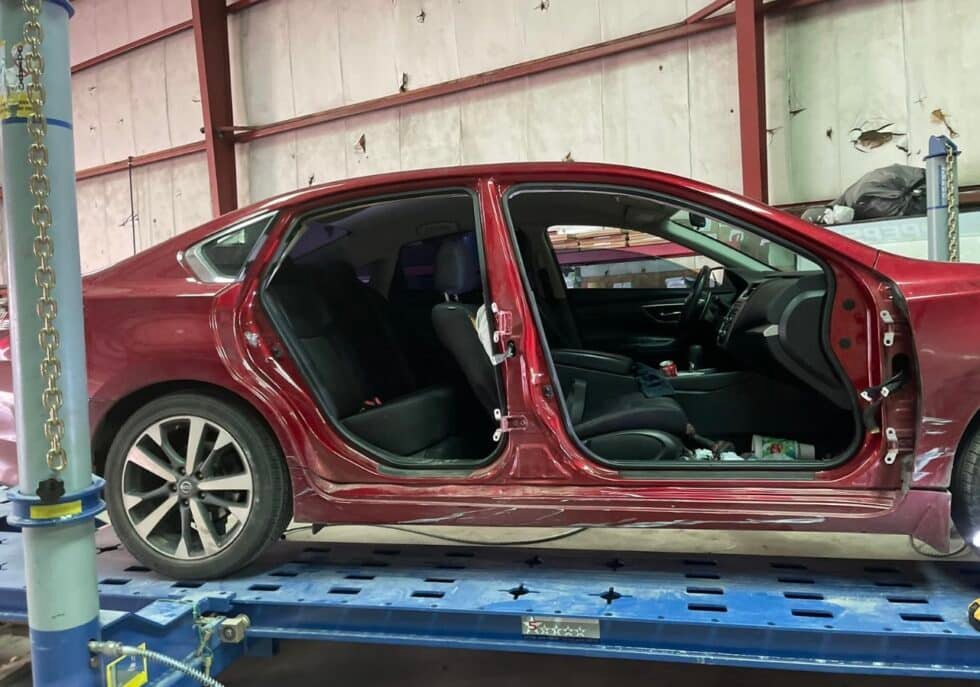
You’re looking at a repair estimate that reads like a foreign language. Codes, hours, and costs stack up fast, and one acronym keeps showing up: R&I. You see it listed next to your door handle, your taillight, or your bumper, parts that look perfectly fine. Why are you paying labor costs for parts that weren’t even hit?
You aren’t being scammed. R&I stands for Remove and Install. It is the standard industry procedure for taking an undamaged part off a vehicle to access a repair zone or to ensure paint covers a panel edge seamlessly. Once the work is done, that same part goes back on. At Syed Brothers Auto Body Shop OKC, we don’t use R&I to pad the bill. We use it to ensure your car leaves our shop safe, rust-proofed, and looking like it did the day it left the factory.
Essential Findings
- We remove an undamaged part to fix the area behind or around it, then reinstall the original part.
- R&I reuses your part; R&R (Remove and Replace) buys a new one.
- Removing trim instead of taping over it prevents paint from peeling months later.
- We must remove the bumpers to inspect and calibrate the crash sensors hidden underneath.
- We don’t guess the price, labor times come from strict industry guides like CCC ONE.
The Real Meaning of R and I in Auto Body Repair
R&I stands for Remove and Install. On your estimate, this code means a technician needs to take a specific part off the vehicle, store it safely, and bolt it back on later. The part itself is not broken, but it is in the way.
Technicians use R&I primarily for access. Imagine you have a dent in the center of your door. We cannot hammer that dent flat or weld it if the glass, speakers, and plastic interior panel are still inside. We have to strip the door down to the bare metal shell to fix it properly. Once the metal is straight and painted, we reinstall those original components.
At Syed Brothers Auto Body Shop OKC, R&I also protects your property. If we need to weld a quarter panel (the rear side of the car), we must remove the back seats and carpet. Welding creates sparks and high heat that can instantly burn fabric or shatter glass. By performing an R&I on the interior, we ensure the only thing that changes on your car is the repair of the accident damage.
Identifying the Critical Differences on Your Repair Bill
It is easy to mix up R&I and R&R, but the difference affects your final bill and the parts used on your car.
R and I (Remove and Install): means we reuse the part. We take it off, put it on a stand, and reinstall it after painting.
R and R (Remove and Replace): means the part is trash. We remove the damaged item and install a brand-new, used, or aftermarket replacement.
Think about a side-mirror. If your door is dented but the mirror is untouched, we R&I the mirror. We take it off so we can paint the door skin underneath it without leaving a tape line. If the mirror itself was clipped and shattered, we R&R the mirror. In that case, you pay for the labor to swap it, plus the price of the new mirror assembly.
According to I-CAR, the leading training organization for collision repair, getting this right is a safety issue. Modern cars have Advanced Driver-Assistance Systems (ADAS). If a bumper is marked for R&I, we know to handle the sensors with extreme care. If it’s marked R&R, a technician might cut wires or toss brackets, assuming new hardware is coming. Mislabeling these steps can lead to delays or sensor failures.
Operation | Action Taken | Parts Cost Involved? | Typical Scenario |
R & I | Part removed, saved, reinstalled. | No | Removing a taillight to paint a bumper cover. |
R & R | Damaged part removed, new part installed. | Yes | Swapping a cracked headlight for a new unit. |
Overhaul | Assembly taken apart completely and rebuilt. | No (usually) | Stripping a bumper cover of grilles, emblems, and sensors. |
Overhaul and Detach and Reset Operations
You may see terms on your estimate that sound like R&I but involve different labor intensities.
Overhaul: This is essentially R&I on a larger scale. This applies to complex assemblies like bumpers, doors, or steering columns. “Overhaul Bumper” means we take the bumper off the car, place it on a work stand, and strip it down completely. We remove the plastic cover, then unclip the grilles, unscrew the fog lights, and detach the wiring harness and sensors. We do this when the main cover needs to be replaced or repaired, requiring every single attached piece to be transferred to the new cover.
Detach and Reset: (Often called Set Back) is a partial R&I. In this scenario, we unbolt a part to create clearance, but we don’t physically remove it from the vehicle. For instance, we might unbolt a fuel tank strap to lower the tank two inches. This gives us room to work on the floor pan without disconnecting fuel lines or draining the tank. It saves labor time compared to a full R&I while still giving the technician the room they need.

Why R and I Charges Are Necessary for Professional Paint Restoration and Dent Repair
A common question we hear is, “Why charge me to take off the door handle? Just tape around it.” Taping is cheaper and faster, but it results in a low-quality repair that will fail. We insist on R&I at Syed Brothers Auto Body Shop OKC for four technical reasons:
- Access for Repair: We can’t fix what we can’t touch. A dent hiding behind a reinforcement bar requires us to remove the interior trim to get our tools in place. Without R&I, structural damage stays hidden.
- Damage Inspection: Plastic bumper covers are flexible, they snap back into shape after an impact. The steel reinforcement bar or foam absorber underneath does not. R&I allows us to take the cover off and verify the structural safety of the car.
- Proper Paint Blending: Paint manufacturers like PPG and Axalta advise against “hard masking” (taping) parts. Paint builds up against the tape. When you peel the tape, it leaves a ridge. Moisture eventually gets under that ridge, causing the clear coat to peel away. R&I allows us to spray paint around the edges of the panel, just like the factory did.
- Corrosion Protection: Welding burns off factory rust protection on the backside of a panel. By R&I-ing nearby parts, we can access the inner cavities to spray wax and sealants, stopping rust from eating your car from the inside out.
How Labor Times for R and I Are Calculated Using Industry Standards
We don’t guess how long it takes to remove a fender or a headliner. The labor hours on your estimate come from rigorous, third-party data.
Software platforms like CCC ONE, Audatex, and Mitchell International conduct time studies on almost every vehicle year, make, and model. They measure the exact time it takes a qualified technician to remove and reinstall a specific part using standard tools. If the guide says R&I for a 2023 Honda CR-V front bumper is 1.5 hours, and the OKC labor rate is $60 per hour, the line item costs $90.
These guides also use “P-Pages” (Procedure Pages) to define the scope. They list exactly what is included in those 1.5 hours, like disconnecting the battery, and what is not included, such as recalibrating a radar sensor. At Syed Brothers, we adhere to these book times to keep our pricing transparent and defensible.
The Role of R and I in Modern Vehicle Safety and ADAS Calibration
Years ago, a bumper was just chrome and steel. Today, it is a computer. R&I operations are now critical for ADAS (Advanced Driver-Assistance Systems).
When we R&I a side mirror, we are often disconnecting a blind-spot camera or a 360-degree sensor. When we R&I a bumper, we are moving proximity sensors and radar units.
If a technician puts these parts back even a fraction of an inch off, or if the paint over a sensor is too thick, the system fails. Your car might slam on the brakes for a phantom obstacle or fail to stop for a real one. This is why Syed Brothers Auto Body Shop OKC follows OEM procedures strictly. An R&I operation today often triggers a mandatory calibration to ensure your vehicle’s safety systems are “aimed” correctly before you get back on the road.
Ensuring R and I Costs are Covered
Insurance adjusters generally accept R&I as a valid step in the repair process. They want the car fixed right to avoid liability. However, they verify that every R&I charge is necessary for the specific accident.
Sometimes, the need for R&I isn’t clear until we start the work. We might remove a fender (R&I) and find a bent bracket underneath. This is “hidden damage.” When this happens, we file a supplement. We photograph the issue and send a report to the insurance company explaining why the extra labor is required. Because we follow industry standards and document everything, Syed Brothers Auto Body Shop OKC has a strong track record with insurers. We justify every R&I charge, so you aren’t stuck paying out of pocket for the work your car actually needs.
R&I is the difference between a cosmetic cover-up and a genuine structural repair. It ensures your paint won’t peel, your sensors will detect hazards, and your vehicle is safe to drive. When you see R&I on your estimate, it means the shop is taking the time to do the job right.
For drivers in Oklahoma City who want factory-grade repairs and honest estimates, Syed Brothers Auto Body Shop OKC is the answer. We handle every R&I, R&R, and calibration with precision to get your vehicle back to pre-accident condition. Contact us today for a free estimate.
Frequently Asked Questions
What Exactly Does R And I Stand For On A Car Repair Estimate?
R and I stand for Remove and Install. This labor code indicates a technician will remove a part from your vehicle, set it aside effectively, and reinstall that same part once other repairs are finished.
This appears when a part is not damaged but blocks access to a repair area or needs to be removed for painting. For instance, removing a door handle (R&I) allows the door skin to be painted without tape lines. You are charged only for the labor time. Since the original part is reused, there is no charge for a replacement part.
Why Am I Paying To Remove Parts That Aren't Broken?
We charge for R&I to ensure the repair lasts. Leaving parts on and taping around them creates "hard paint lines" that eventually peel and flake, ruining the finish. Technicians must remove undamaged parts to access the backside of dents or to remove flammable interiors (like carpets) before welding near them.
While R&I costs more upfront than masking, it prevents rust and paint failure, protecting your vehicle's resale value and warranty.
Is R And I Different From Replacing A Part?
Yes. R&I (Remove and Install) means we reuse your existing part. R&R (Remove and Replace) means we discard your old part and install a new one. An R&I line item shows only labor cost. An R&R line item shows labor cost plus the price of the new part.
We only select R&R if the part is damaged beyond repair. We use R&I to save you money on parts while ensuring proper access for the main repair.
How Do Shops Determine The Labor Time For R And I?
Shops do not guess these times. We use third-party estimating platforms like CCC ONE, Mitchell, and Audatex, which perform time studies on specific vehicles. The guide provides a set hour rating (e.g., 0.5 hours). This is multiplied by the shop's labor rate. If the guide says 1.0 hour and the rate is $60/hr, the cost is $60.
Times vary by vehicle. R&I for a bumper on an old truck takes less time than on a modern luxury sedan loaded with sensors and cameras.
Will Insurance Cover R And I Costs?
Yes, insurance companies routinely pay for R&I because it is a standard procedure required for a correct, safe repair. The adjuster reviews the estimate to confirm the R&I is necessary. They will approve R&I of a headlamp to paint a fender, but might question it if the damage is on the other side of the car.
If an insurer questions a valid R&I charge, Syed Brothers Auto Body Shop provides photos and manufacturer procedures to justify the labor and get it approved.
What If The Shop Finds More Damage After Performing An R And I?
This happens frequently. Removing a bumper cover (R&I) often reveals a crushed impact absorber or bent frame rail that was invisible from the outside. We pause work to document the new damage. We write a "supplement" estimate and submit it to the insurance company or customer for approval.
We never ignore hidden damage. Using R&I to find these issues ensures the structural integrity of the car is restored, not just the cosmetics.
Does R And I Affect My Factory Warranty?
When done correctly, R&I protects your warranty. By removing parts properly rather than forcing repairs around them, we avoid damaging fasteners or scratching adjacent panels. If a shop breaks a clip or fails to reconnect a sensor during R&I, that specific issue might not be covered by the manufacturer. This is why choosing a qualified shop is essential.
Paint manufacturers (like Axalta) often void warranties if trim was taped off instead of R&I, because peeling is almost guaranteed to occur at the tape line.
Why Is R And I Required For A Simple Paint Job?
Paint must wrap around the edges of a panel to seal it. If a molding or handle is left on, the paint bridges the gap between the panel and the part. Vibrations and temperature changes cause the paint bridge to crack. Water enters the crack, travels under the clear coat, and causes the paint to lift off in sheets.
R&I is the only way to achieve a seamless repair where the new paint looks identical to the factory application, with no visible edges.
Can I Ask The Shop To Skip R And I To Save Money?
Skipping R&I might save a small amount on labor now, but it usually results in a repair that looks obvious and degrades quickly. Reputable shops, including Syed Brothers, generally refuse requests to skip necessary R&I because we cannot provide a warranty on work we know will fail.
A vehicle with visible tape lines and peeling paint around handles loses significant resale value, costing you more than the price of the R&I labor.
What Is The Difference Between R And I And Detach And Reset?
R&I implies fully removing the part from the car. Detach and Reset (or Set Back) means unbolting the part to move it slightly out of the way without full removal. Detach and Reset usually costs less than R&I because it involves fewer steps (e.g., no need to unplug complex wiring or drain fluids).
We use Detach and Reset when we need just an inch of clearance. We use R&I when the part physically blocks the repair or must be protected from heat and dust.
Do R And I Apply To Mechanical Parts Too?
Yes, R&I applies to any part attached to the vehicle, including radiators, suspension struts, steering racks, and condensers. In a front-end wreck, we often R&I the radiator to fix the core support frame. Even if the radiator is undamaged, it must be moved to allow the frame repair.
R&I of mechanical parts often triggers extra costs for draining and refilling fluids (coolant, refrigerant), which are billed separately from the labor.
Are R And I Necessary For Paintless Dent Repair (PDR)?
Yes, PDR technicians frequently require R&I. They use metal rods to push dents out from the backside of the panel. To reach a dent in the roof, they must R&I the headliner. To fix a door ding, they often R&I the interior door panel or window glass.
Even with R&I costs added, PDR is typically cheaper than traditional bodywork and painting, and it preserves your original factory paint.